

For professional drivers, the “office” isn’t a cubicle, it’s the cab of a truck. While most safety discussions focus on what happens on the road, your physical well-being inside the vehicle is just as critical to a long, successful career. Long-haul driving introduces unique stresses on the body, specifically from static postures and constant whole-body vibration. Over time, these factors can lead to debilitating chronic back pain or carpal tunnel syndrome if not managed correctly.
The following guide breaks down how to optimize your environment and habits to keep you healthy and injury-free.
Setting Up Your Command Center
Comfort is a safety requirement. A poorly adjusted seat forces your muscles to work harder to stabilize your body, leading to fatigue and slower reaction times.
- Finding the Right Height: Elevate your seat to a point where you have a commanding view of the road. However, ensure your feet aren’t dangling. You should be able to depress the pedals using your entire foot rather than just your toes.
- The 10-Inch Rule: Distance matters for more than just comfort. Maintain at least 10 inches between your chest and the steering wheel. This gap provides the necessary clearance for airbag deployment, reducing the risk of impact injuries.
- Lower Back Health: Utilize your seat’s lumbar support. Adjust it until it meets the curve of your lower back evenly. If there is a gap between your spine and the seat, your muscles will eventually strain to fill that space.
- Headrest Alignment: Your headrest is a safety device, not a pillow. Align the top of the rest with the top of your head, keeping the distance between the back of your head and the cushion within four inches.
Steering for Longevity
Many drivers learn “hand-over-hand” steering early on, but for professional, long-distance driving, the Push/Pull Method is superior.
Keep your hands at the 9 o’clock and 3 o’clock positions. As you turn, one hand pushes the wheel upward while the other pulls it down. This technique minimizes repetitive strain on the wrists and keeps your arms out of the “deployment zone” of the steering wheel airbag. It’s a small change that significantly reduces the wear and tear on your joints over thousands of miles.
The Critical Transition: Entering and Exiting the Cab
Statistics show that a large percentage of driver injuries occur while the vehicle is stationary. Slips, trips, and falls during entry and exit are leading causes of workers’ compensation claims in the industry.
To stay safe, adhere strictly to the 3 Points of Contact rule. This means having either two hands and one foot, or two feet and one hand, firmly planted on the vehicle at all times.
Always face the vehicle when climbing in or out; jumping from the cab or exiting while facing outward puts immense pressure on your knees and ankles and increases the likelihood of a fall. Use only designated handgrips and steps for leverage. While it might be tempting to grab the door handle or step on the wheel hub, these are not stable points of contact and can easily lead to a slip.
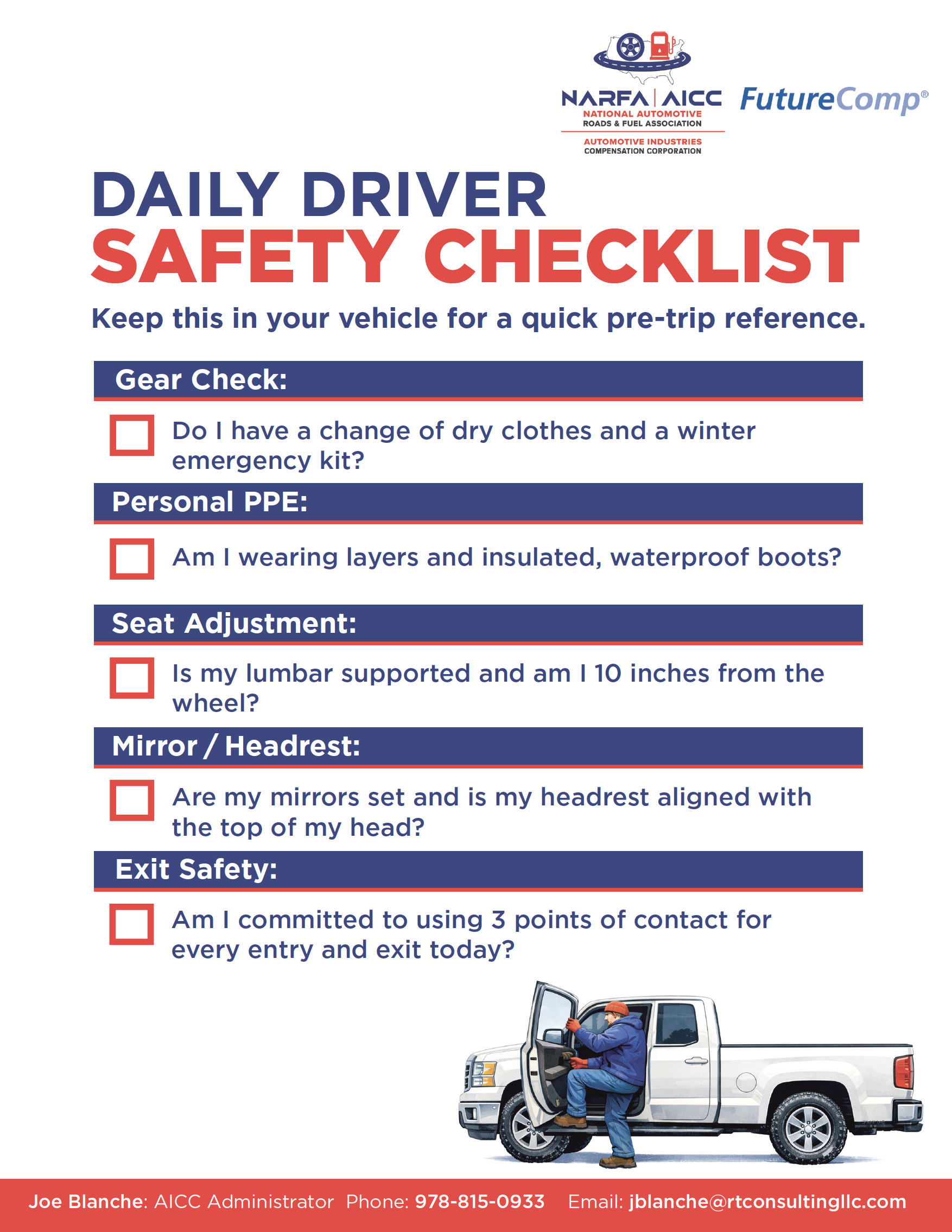
Download safety checklist here (PDF)
Your Daily Safety Checklist
Before you head out, take sixty seconds to run through this mental (or physical) checklist. Consistency is the best defense against chronic injury.
- Gear Check: Do I have a change of dry clothes and a winter emergency kit?
- Personal PPE: Am I wearing appropriate layers and insulated, waterproof boots?
- Seat Setup: Is my lumbar supported, and am I at least 10 inches from the wheel?
- Visibility: Are my mirrors dialed in, and is my headrest aligned with the top of my head?
- Exit Strategy: Am I committed to using 3 points of contact for every stop today?
Protecting Your Team and Your Bottom Line
Being aware of these ergonomic habits is the first step in building a true safety culture. For businesses in Massachusetts, these efforts are supported by the Automotive Industries Compensation Corporation (AICC), our Workers’ Compensation program sponsored by NARFA. Since 1995, the AICC has helped companies manage risks through industry-specific loss control services and proactive claims management.
Contact us today to learn more about the AICC and NARFA.
Recent Posts

Why Your Best Benefit Plan is the One Your Team Actually Uses
The goal of any benefits package is to provide security and value. Yet, in many businesses, employees feel more confused than supported. When your team [...]

April Is Distracted Driving Awareness Month: What NARFA Members Need to Know
If you spend any time on the road, you’ve seen it: the light turns green, the car in front doesn’t move, and the driver is [...]

The AICC Claims Approach for Our Members: Faster Response, Better Control, Stronger Outcomes
In the automotive, roads, fuel, or fleet industries, a workers’ compensation claim can affect more than one employee. It can disrupt production, strain supervisors, pull [...]