
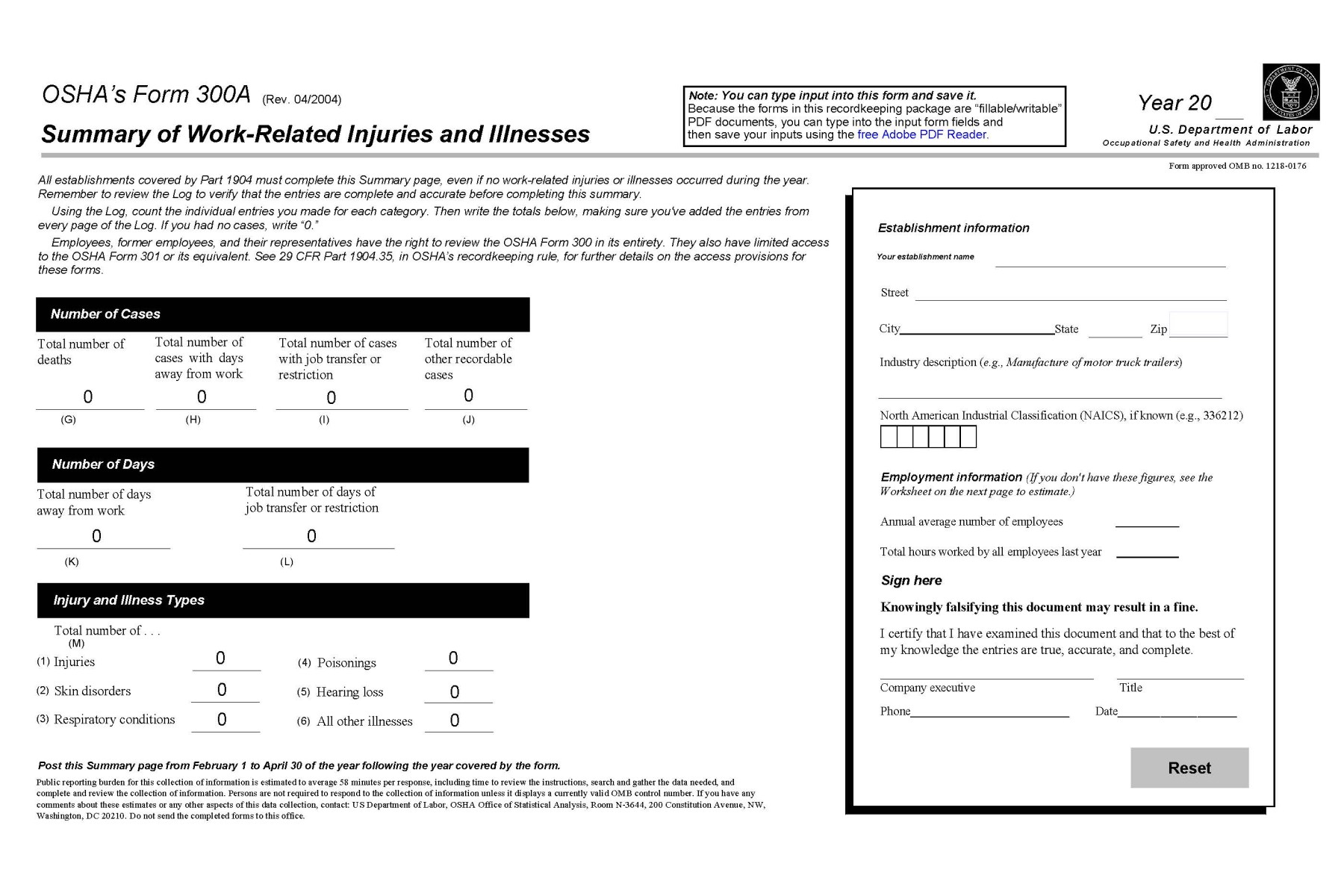
Introduction to OSHA Form 300A
The Occupational Safety and Health Administration (OSHA) requires employers to maintain records of work-related injuries and illnesses, one of which is the OSHA Form 300A, also known as the Summary of Work-Related Injuries and Illnesses. This form is critical for both compliance with federal regulations and for promoting a safer workplace environment.
Timeline for OSHA Form 300A
- Completion: Employers must complete the OSHA Form 300A by the end of the calendar year, summarizing all recordable injuries and illnesses that occurred during that year.
- Posting: The form must be visibly posted in the workplace from February 1st to April 30th of the year following the year covered by the form. For instance, the OSHA Form 300A for the year 2024 would need to be posted from February 1, 2025, to April 30, 2025.
- Electronic Submission: Certain employers are required to submit their OSHA Form 300A data electronically via OSHA’s Injury Tracking Application (ITA) by March 2nd of the following year. This applies to establishments with 250 or more employees, as well as those with 20-249 employees in designated high-risk industries. Starting in 2024, employers with 100 or more employees in specific high-hazard industries must also submit Forms 300 and 301. (link https://www.osha.gov/injuryreporting)
The Importance of OSHA Form 300A
- Safety Awareness: The form serves as a key tool for employees to understand the safety risks associated with their workplace. By posting this summary, employers inform workers about the types of incidents that have occurred, fostering a culture of safety awareness.
- Legal Compliance: Proper completion and posting of the Form 300A are essential for compliance with OSHA regulations. Non-compliance can lead to penalties, which can be quite significant depending on the severity of the oversight.
- Data Analysis: The data collected via Form 300A helps OSHA in analyzing occupational injury and illness trends across industries, which in turn guides the development of safety policies and regulations.
- Injury Prevention: By reviewing the data from Form 300A, companies can identify patterns or frequent types of injuries, allowing them to take corrective actions to prevent future occurrences. This can involve changes in workplace practices, equipment, or training programs.
Useful OSHA Links for Further Information
- OSHA’s Recordkeeping Page provides detailed guidance on how to comply with recordkeeping requirements, including tutorials and Q&As. https://www.osha.gov/laws-regs/regulations/standardnumber/1904/1904.29
- OSHA Injury Tracking Application (ITA) – Here, employers can submit their injury and illness data electronically. https://www.osha.gov/injuryreporting
- OSHA Form 300A Information – This page offers access to the forms themselves and additional resources on how to fill them out correctly. https://www.osha.gov/laws-regs/regulations/standardnumber/1904/1904.29
The OSHA Form 300A is a regulatory requirement and an important aspect of workplace safety. By adhering to the timeline for its completion and posting, employers not only comply with federal laws but also contribute to a safer, more transparent work environment. Understanding and implementing these processes can lead to better safety outcomes, fewer workplace incidents, and a healthier workforce.
Recent Posts

Massachusetts PFML in 2027: What the New Contribution Structure Means for Employers
If you run a business in Massachusetts, the way your Paid Family and Medical Leave (PFML) contributions are structured changes on January 1, 2027. Here's [...]

The OSHA Hazard Communication Deadline Is Coming: What It Means for Your Business
If your business keeps solvents, paints, fuels, adhesives, or cleaners on site, OSHA's Hazard Communication Standard applies to you, and it has a new deadline [...]

What the DOL’s New Mental Health Parity Enforcement Policy Means for Your Health Plan
Mental health coverage rules for group health plans shifted again this fall, and the change is worth understanding whether you already offer a plan or [...]