
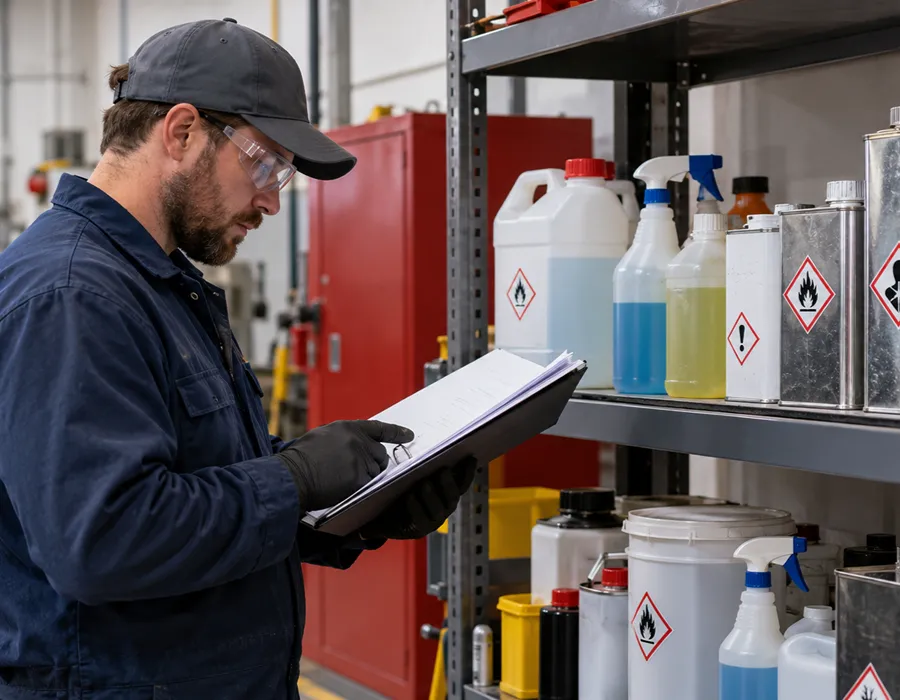
If your business keeps solvents, paints, fuels, adhesives, or cleaners on site, OSHA’s Hazard Communication Standard applies to you, and it has a new deadline worth putting on the calendar. The standard, often called the “right to know” rule, is one of OSHA’s most frequently cited every year. OSHA updated it in 2024 to line up with the latest global system for classifying chemicals, and the clock is now running on when employers need to catch up.
Here is the plain version.
What changed
In 2024, OSHA revised the Hazard Communication Standard to align with the seventh revision of the Globally Harmonized System, the international framework for classifying and labeling chemicals. In short, some chemicals get reclassified, labels and safety data sheets get updated, and a few new hazard categories come into play, including changes for flammable gases, certain explosives, and aerosols.
OSHA later pushed the compliance dates back by four months to give everyone time to work through the new guidance. That extension was published in January 2026.
The deadline that matters to you
This is where a lot of coverage gets confusing, so here is the distinction that matters. There are two sets of deadlines, and they fall on two different groups.
- Chemical manufacturers, importers, and distributors had to reclassify substances and update their labels and safety data sheets by May 19, 2026. That date has already passed, which means updated labels and data sheets for individual chemicals are already making their way to you.
- Employers who use those chemicals have until November 20, 2026 to update workplace labeling, refresh their written hazard communication program, and train workers on any newly identified hazards for substances.
For mixtures, the timeline runs longer. Manufacturers have until November 19, 2027, and employers have until May 19, 2028.
What you actually need to do
Worth saying plainly: this update is lighter on employers than the 2012 overhaul was. It does not require comprehensive retraining of your whole workforce, because it does not rewrite everything. It mostly reaches you through reclassified chemicals and updated labels as they arrive. Still, a short checklist keeps you clean:
- Review your chemical inventory. Identify anything you use that has been reclassified.
- Get the updated safety data sheets. Make sure current versions are on hand and available to employees.
- Update your labels and written program. Reflect the new classifications in your workplace labeling and your written hazard communication plan.
- Train on what changed. Cover any newly identified hazards and updated label elements with affected employees.
Why it is worth the hour it takes
Chemical exposure incidents are expensive, and they are preventable. Hazard communication sits near the top of OSHA’s most cited list year after year, which tells you how often it gets overlooked. Beyond the citation risk, a workforce that can read a label and knows where the data sheets live is a workforce that has fewer incidents and fewer claims. For more on where this fits among the common OSHA pitfalls, see our breakdown of OSHA’s top 10 violations and how to avoid them.
This is general information, not legal advice. If you are unsure how the standard applies to your specific operation, confirm it against OSHA’s Hazard Communication guidance or your safety advisor before the deadline.
Staying ahead of requirements like this is easier with support behind you. For Massachusetts employers in our industries, NARFA sponsors AICC, a self-insured workers’ compensation group built specifically for automotive, construction, trucking, fuel, and fleet-based businesses. It has a long track record of success and strong, profitable performance, and members get loss control and safety support that helps them handle exactly this kind of compliance work before it becomes a problem. You can learn more on the NARFA sponsored Massachusetts workers’ compensation page.
Good safety practices and a strong workers’ compensation program work the same way. Both pay you back by keeping your people healthy and your business running.
Recent Posts
The OSHA Hazard Communication Deadline Is Coming: What It Means for Your Business
If your business keeps solvents, paints, fuels, adhesives, or cleaners on site, OSHA's Hazard Communication Standard applies to you, and it has a new deadline [...]

What the DOL’s New Mental Health Parity Enforcement Policy Means for Your Health Plan
Mental health coverage rules for group health plans shifted again this fall, and the change is worth understanding whether you already offer a plan or [...]

Forklift Safety on a Shared Floor: What Operators and Pedestrians Each Need to Do
A forklift and a person on foot often share the same floor, and each has a job to do to keep that arrangement safe. Operators [...]